(First movement: the land and the dream)

There was a time in this fair land when the railroad did not run
When the wild majestic mountains stood alone against the sun
Long before the white man and long before the wheel
When the green dark forest was too silent to be real

But time has no beginnings and history has no bounds
As to this verdant country they came from all around
They sailed upon her waterways and they walked the forests tall
Built the mines, the mills and the factories for the good of us all

And when thе young man's fancy was turnin' to the spring
The railroad men grеw restless for to hear the hammers ring
Their minds were overflowing with the visions of their day
And many a fortune lost and won, and many a debt to pay

(Second movement: visions of a new nation)

For they looked in the future and what did they see
They saw an iron road runnin' from the sea to the sea
Bringin' the goods to a young growin' land
All up through the seaports and into their hands

"Look away," said they, "across this mighty land,
From the eastern shore to the western strand."

Bring in the workers and bring up the rails
We gotta lay down the tracks and tear up the trails
Open her heart let the life blood flow
Gotta get on our way 'cause we're movin' too slow

Bring in the workers and bring up the rails
We're gonna lay down the tracks and tear up the trails
Open her heart let the life blood flow
Gotta get on our way 'cause we're movin' too slow

Get on our way 'cause we're movin' too slow

(Third movement: nation building and legacy)

Behind the blue Rockies the sun is declinin'
The stars, they come stealin' at the close of the day
Across the wide prairie our loved ones lie sleeping
Beyond the dark oceans in a place far away

We are the navvies who work upon the railway
Swingin' our hammers in the bright blazin' sun
Livin' on stew and drinkin' bad whiskey
Bendin' our backs 'til the long days are done

We are the navvies who work upon the railway
Swingin' our hammers in the bright blazin' sun
Layin' down track and buildin' the bridges
Bendin' our backs 'til the railroad is done

(Back to second movement)

So over the mountains and over the plains
Into the muskeg and into the rain
Up the St. Lawrence all the way to Gaspé
Swingin' our hammers and drawin' our pay

Layin' them in and tyin' them down
Away to the bunkhouse and into the town
A dollar a day and a place for my head
A drink to the livin', a toast to the dead

(Interlude: climax)

Oh the song of the future has been sung
All the battles have been won
On the mountain tops we stand
All the world at our command
We have opened up the soil
With our teardrops and our toil

(Back to first movement)

For there was a time in this fair land
When the railroad did not run
When the wild majestic mountains
Stood alone against the sun

Long before the white man and long before the wheel
When the green dark forest was too silent to be real

When the green dark forest was too silent to be real
And many are the dead men
Too silent to be real
| verdant (青翠) : from Old French verdeant, bright green colour of lush grass, of a countryside rich in vegetation. |
| prairie (草原) : a wide area of flat land, predominantly covered with grass, especially in North America. |
| navvies (苦工) : "navigators", manual laborers who performed heavy work on large-scale civil engineering projects. |
| muskeg (沼澤) : a North American swamp or bog consisting of a mixture of water and partly dead vegetation. |
 Click to enlarge (click again to close)
點擊放大(再擊關閉)
Click to enlarge (click again to close)
點擊放大(再擊關閉)
Canada was founded in 1867 as a federation of British North American colonies. However, railway construction was a key factor in its development, promoting national unity and expansion, most notably the transcontinental Canadian Pacific Railway (CPR). This railway not only connected the eastern and western provinces, but also spurred economic development, encouraged immigration and development in the west, and thus solidified Canada's federal structure.
"Canadian Railroad Trilogy" describes the building of CPR, completed in 1885. The CPR was merged with the Kansas City Southern Railway in 2023 to form the Canadian Pacific Kansas City.
When Gordon Lightfoot sat down to write, the possibilities were as endless as the open expanse that fell before the workers who built the railway. Lightfoot drew some inspiration from American singer/songwriter Bob Gibson and his commemoration to the American Civil War, known as the ‘Civil War Trilogy’.
I got the idea to write it long from a mentor of mine named Bob Gibson, who is a major figure in the folk revival. He had written a song called ‘Civil War Trilogy,’ which had a slow part in the middle, and I followed that pattern. Without a piece of input like that, I probably wouldn’t have been able to approach the song on that basis.The beautiful lyrical ballad reflects both the optimism and opportunism of the great age of railroad building, while acknowledging the harsh realities, brutal conditions and back-breaking labor faced by the "navvies," the workers who build the iron road largely by hand.
Regarding this epic song, the author of a book on the history of CPR once told Lightfoot, "You did more good with your song than I did with my entire book on the same subject."
In an interview with The Telegraph, Lightfoot indicated that upon meeting Queen Elizabeth II, she told him how much she enjoyed the song.
In 2001, "Canadian Railroad Trilogy" was honoured as one of the Canadian MasterWorks by the Audio-Visual Preservation Trust of Canada.
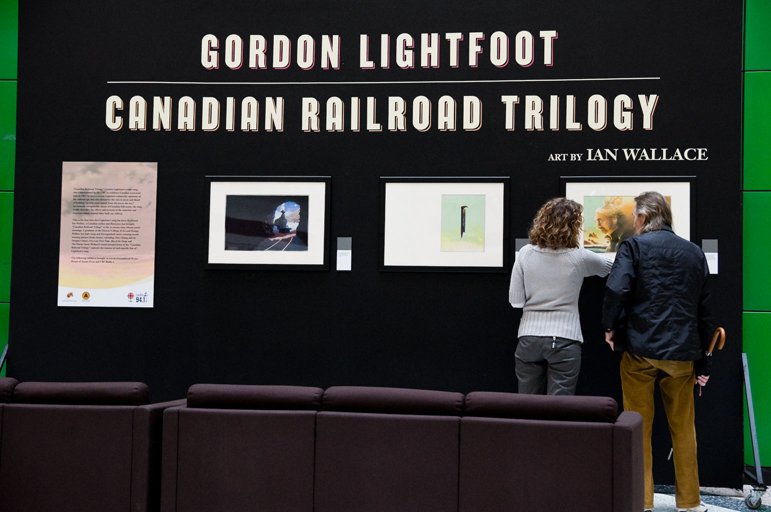
The song lyrics was so captivating that in 2011 "Canadian Railroad Trilogy" was published as a picture book, illustrated by Ian Wallace. Check out book excerpt and teacher's guide in this webpage. In the photo shown, Gordon Lightfoot attended an exhibition of drawings by Ian Wallace at the CBC Toronto Headquarters in 2010.
加拿大於 1867 年立國,由英屬北美殖民地組成聯邦,而鐵路建設是發展的關鍵因素,促進國家統一和擴張,尤其以橫貫大陸的加拿大太平洋鐵路 (Canadian Pacific Railway = CPR) 為代表。這條鐵路不僅連接東部和西部各省份,還帶動經濟發展、鼓勵西部的移民和開發,從而鞏固加拿大的聯邦結構。
Canadian Railroad Trilogy 講述 CPR 的建設歷程,於1885年竣工。2023年,CPR 與 Kansas City 南方鐵路合併,組成 Canadian Pacific Kansas City。
創作開始時,Gordon Lightfoot 一片空白,無限可能。猶如修建鐵路的工人,面對眼前空間,一望無盡。Lightfoot 說他的靈感,來自美國創作歌手 Bob Gibson 一首作品(Civil War Trilogy,內戰三部曲),紀念美國內戰:
綿延不絕的寫法,來自我的導師 Bob Gibson,民謠復興運動的重要人物。他的一首《內戰三部曲》,中間有一段節奏變慢。其實我只是照辦煮碗,依照同樣的模式。如果沒有這首歌曲幫忙,可能我根本無法以此為基礎,構思這首歌。優美而抒情的民謠歌詞,反映鐵路建設的偉大時代,充滿樂觀和機會主義。同時也承認「navvies」(用手修建鐵路的工人)所面臨的嚴酷現實、苛刻條件和艱苦勞動。
關於這首史詩式作品,一位曾撰寫 CPR 歷史書籍的作者,對 Lightfoot 說:「你這一首歌太好了,勝過我同一主題的整本書。」
Lightfoot 接受《每日電訊報》採訪時表示,在覲見英女王時,伊莉莎白二世曾告訴他,她非常喜歡這首歌。
2001年,加拿大影音保護信託基金會宣佈,評定 Canadian Railroad Trilogy 為加拿大傑作(Canadian MasterWorks)之一。
引人入勝的歌詞,化成圖畫書,由 Ian Wallace 繪製,於 2011年出版《Canadian Railroad Trilogy》。查看書摘或教師指南,點擊此網頁。如照片所示,2010年 Gordon Lightfoot 在加拿大廣播公司(CBC)多倫多總部,參觀 Ian Wallace 的繪畫展。