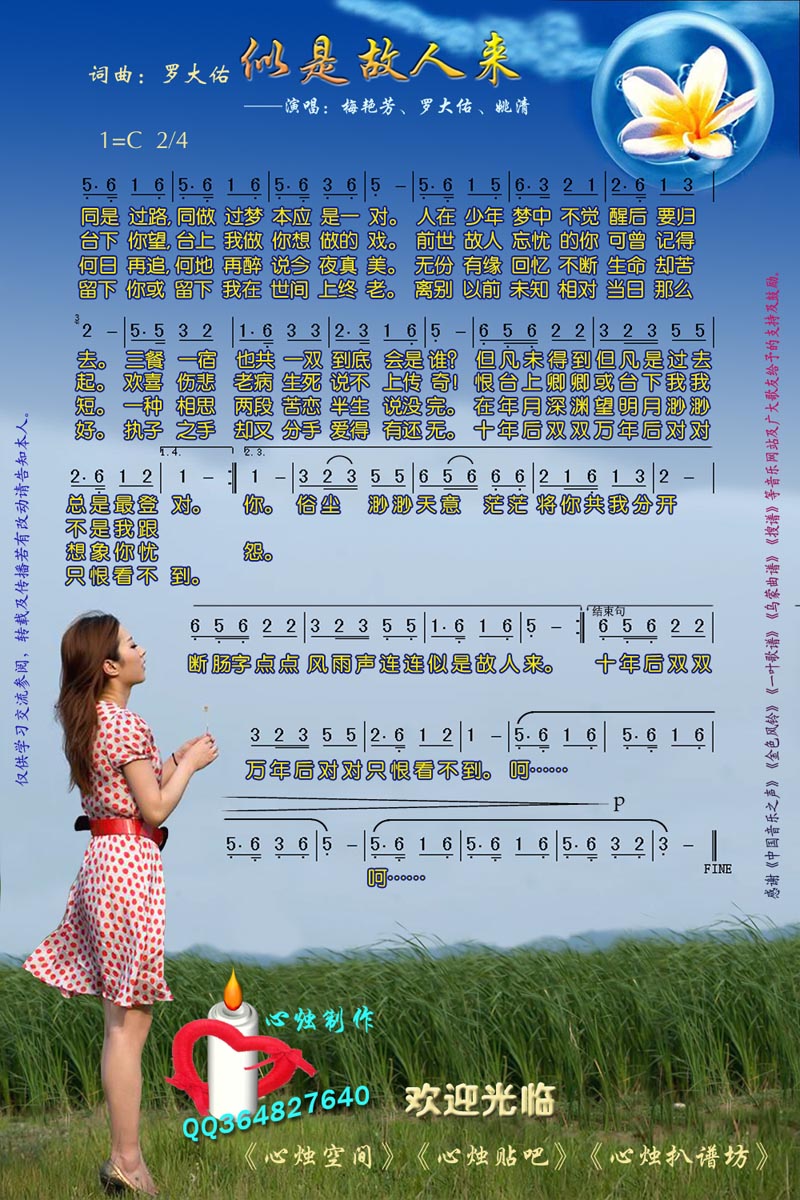
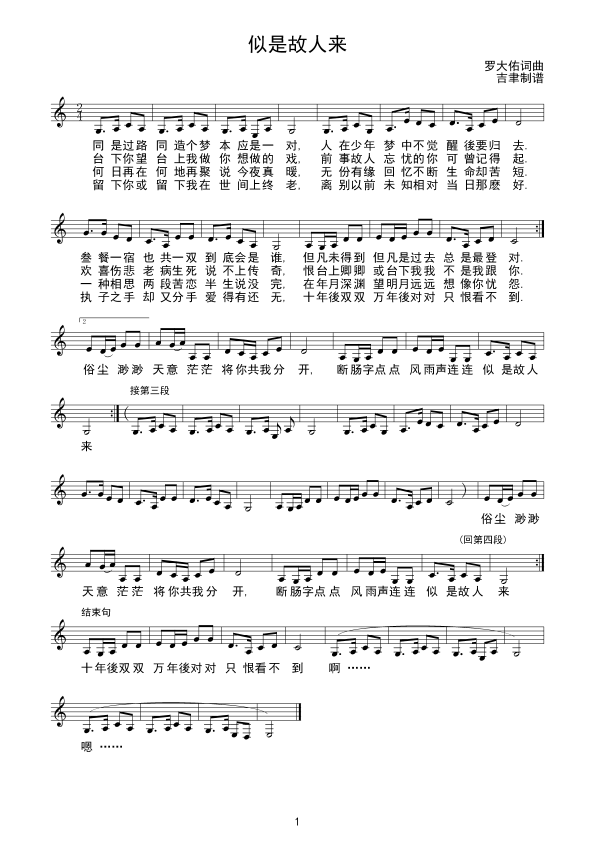
For those with an instrument to play this song, refer to the notation and piano sheets shown.
點擊放大(再擊關閉)
附上樂曲簡譜和鋼琴曲譜。有樂器演奏這首歌的,會感興趣。
Notes簡介
Click to enlarge (click again to close)
點擊放大(再擊關閉)
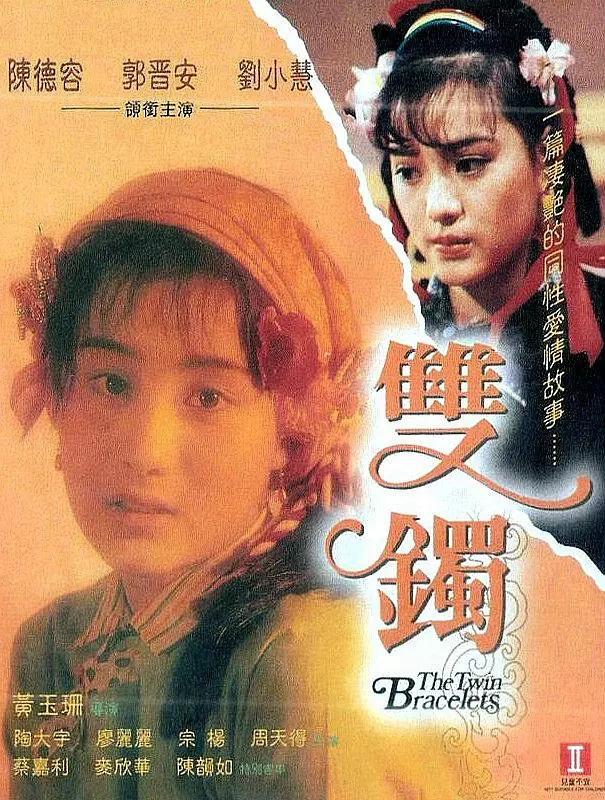
This is the theme song of the 1991 movie "The Twin Bracelets".
As the poster description tells, the film is about a tragic love story of the same sex.
The film was screened at the 13th Créteil International Women's Film Festival.
At the 16th San Francisco International LGBT Film Festival, it won the best feature film award as voted by the audience.
"Like an old friend comes" was composed by Lo Tayu (羅大佑), lyrics by Lin Xi (林夕), arrangement by Fabio Carli (花比傲), performed by Anita Mui (梅艷芳).
The following prizes were well deserved:
1991 Radio Hong Kong Top Ten Chinese Golden Songs: Best Chinese (Popular) Lyrics Award,
1992 the 11th Hong Kong Film Awards: Best Original Film Song Award.
This piece of music brings together the great creators and singers in Chinese music.
The lyrics is very beautiful, and the emotional features are very appropriate.
With an incisive interpretation by Anita Mui's unique voice, the final presentation is delicate and exquisite. This song is indeed an outstanding piece of work.
Albert Leung(梁偉文)takes his pen name Lin Xi(林夕)from the Chinese word for 'Dream'(夢).
In simplified Chinese this is 梦, evoking sunset(夕) in the forest(林), a beautiful mood.
Known as the "Master of Dreams", Lin Xi became a lyricist in the mid-1980s.
He is one of the most prolific lyricists in Hong Kong's music scene.
In an interview, the reporter asked Lin Xi: "You have written so many lyrics, do you have your favorite?" Lin Xi replied, "Those in the future, and those in the past, are always the best match(登對)."
— from the lyrics of this song.
Lin Xi is a genius lyricist. He can compose vernacular archaic sentences effortlessly. This song lyrics is a success due to the following:
First, the expressions are elegant and timeless. Except for the middle transition, there are four paragraphs making up the whole.
The basic structure is the same, and the contrast is quite neat. The smooth flowing words are clear, with far-reaching implications.
Each paragraph rhymes separately, which makes the lyrics easy to fit in and easy to sing along.
Second, it describes the richness of emotions. There is ignorant love, suspicious love, and passionate love. There is parting and sorrow, there is helplessness and entanglement.
It contains a variety of emotions in everyday life, which is hard to find in other lyrics.
Third, it is filled with remarkable sayings and aphorisms. They are very natural, with no sense of stacking up. Compared with other lyrics, this is particularly prominent.
Fourth, its merit lies in the completeness of the description. The emotions at all stages of life are accurately refined. Doing so within a short lyrics, one must have a touch of magic.
Fifth, in the middle section there is a hint of fate and universal truth between the lines. This is because Lin Xi believes in Buddhism, adding Buddhist philosophy in his works.
When Lin Xi pens this lyrics, he uses a lot of antithetical, parallel, and repetitive techniques. The writing is beautiful and eloquent. The artistic conception penetrates with traditional Chinese flavor. What is commendable is that the full text does not have any artificial or obscure quotations. The sentences are gracious with life-like breaths. Everyone can understand the words, putting the words to their hearts.
In the original version of this song, Anita Mui's interpretation is natural, simple, elegant, and full of helplessness. The words and sentences are all touching. She speaks softly about the sadness, melancholy and nostalgia in it.
At the end of the song, she hums seemingly carefree. The yearning and unwillingness in her heart, the faint grievance, she expresses without leaving a trace.
Known as a "Daughter of Hong Kong", Anita Mui sings this song on multiple occasions, always wearing a thin smile. Singing a sad song with a smiling hint reflects her unique understanding of the lyrics: life is just like this, so why not face it with a smile?
Recalling this theme song of "The Twin Bracelets", Lo Tayu said: "This song was created when I left Taiwan and came to Hong Kong to beg for a living. I had been constantly writing songs and composing soundtracks for movies."
For this song composition, his style follows the Chinese tradition: a simple melody structure that haunts the listener's mind. He really deserves the title of "Godfather of Pop Music."
At a concert to commemorate Anita Mui, Lo Tayu lamented, "There was a friend, and I collaborated with her in writing songs. This friend left us already. To me, she truly represents the artist: she works until she falls, with the last bit of blood and sweat in her life. I dedicate this song 'Like an old friend comes' to our Miss Anita Mui."
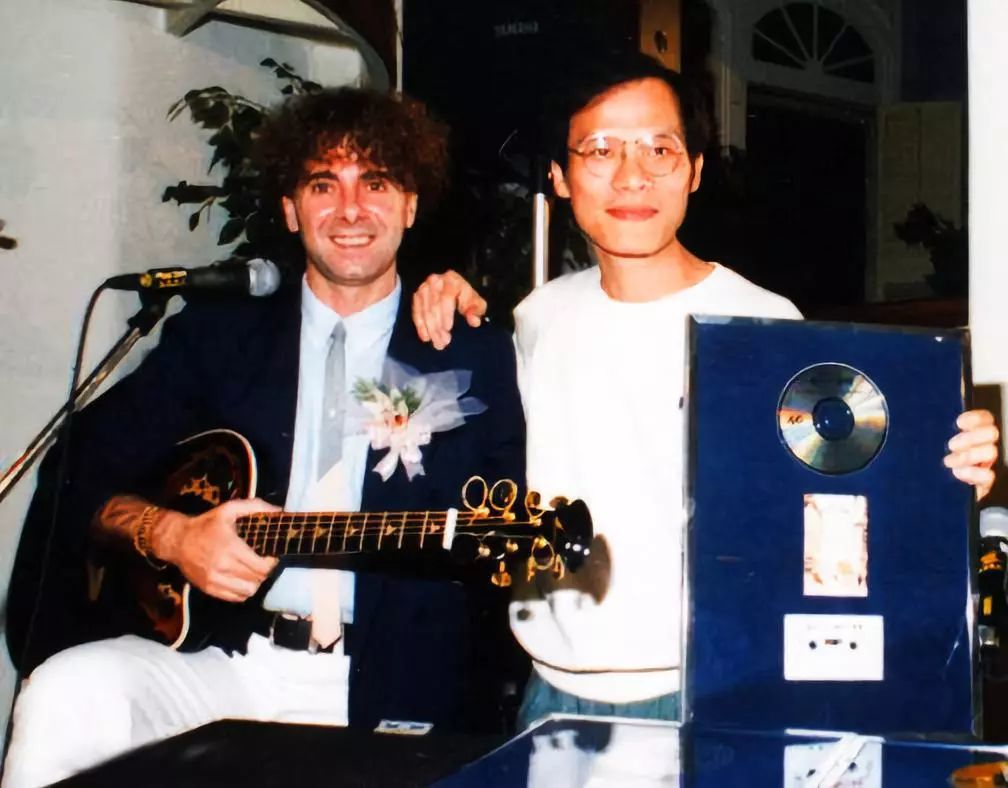
In music creation, few people will notice the arrangement of a song. But when it comes to Lo Tayu, you have to know Fabio Carli(花比傲). His Chinese name was an idea by Lin Xi.
Fabio Carli came from the romantic Italy. When he first came to Hong Kong in 1986, he only wanted to stay for a few months. He never thought that the stay would last for eleven years. At that time, he never thought about taking a Chinese name to be present in this oriental music world.
In 1990, the smug Lo Tayu came to Hong Kong. He cooperated with Taiwan's Rolling Stone Records to establish "Music Factory" in Hong Kong. He invited Lin Xi and Fabio. The three creative musicians: from Taiwan, Hong Kong, and Italy, formed the lineup of "Music Factory".
Lo Tayu translated the name Fabio to Chinese: 花比奧. He asked Lin Xi for an opinion, and Lin Xi thought of replacing 奧 by 傲, meaing 'proud of':
The dying lotus has no cover for heavy rain,
but the withered chrysanthemum still has proud frost branches.
Lo Tayu regarded Fabio as his brother in the music industry. He said that whenever they meet, their chords or fate began to resonate.
"Like an old friend comes" was included in "Queen's Road East", the first album released by "Music Factory" in 1991.
For this song, the arrangements include guzheng(古箏), Chinese flute, string music, and harmony.
The introduction is brisk and bright.
The initial melody has little fluctuation, and the accompaniment is mainly guzheng, later adding male chorus harmonies.
The middle interval has larger vocal range, and stronger string tone beats.
The chorus harmonies form a major climax of the whole song.
Then there is a pass of the flute, playing the first melody.
After a vocal repeat, Anita Mui performs wordless humming.
The song closes with a non-tonic "E".
Zhang Changxiao(張長曉), a scholar who traveled to Italy, likened Fabio as the "Marco Polo in the music scene of Hong Kong." He once commented on Fabio:
His arrangement and composition have a Chinese form of affection, which will often touch you. It is a moving feeling, like a poet talking about his unique cherishing for the East, the kind of fancy combination of Italian folk songs and oriental charm.
Touching feelings have nothing to do with country or nation. In the works of Fabio, we can really see that music knows no national boundaries, and art can combine east and west.
梅艷芳 似是故人來【4:00】
Anita 2003 Classic Moment Concert.Anita 2003年 經典金曲 Classic Moment 演唱會。
梅艷芳 似是故人來【3:53】
Music video with lyrics and thoughtful scenes.歌詞 MV,視頻畫面有心思。
似是故人來【3:51】
Lyrics music video, with precious photos of Anita Mui and Leslie Cheung. (張國榮) 歌詞 MV,梅艷芳與張國榮的珍貴合影。
《大時代》插曲《似是故人来》/梅艷芳【3:52】
Classic interlude for the drama "Big Times".【大時代】插曲,經典。
【似是故人來】梅艷芳【3:54】
The Seven Sisters (2001 TV series) Love Between the Worlds.七姊妹(2001年電視劇)之隔世情。
梁詠琪 Gigi Leung - 似是故人來【4:25】
Outstanding Youth Concert in 27 November 2022.2022年11月27日 芳華絕倫演唱會。
何韻詩,似是故人來【4:43】
A cover by Denise Ho (何韻詩) . Video shows Yao Guisheng (姚桂生) in drama "Hero", performed by Chan Wei (陳煒).【梟雄】姚桂生(陳煒演出)。
何韻詩「似是故人來」MV【5:30】
A cover by Denise Ho (何韻詩) . Music video is directed by Guan Jinpeng (關錦鵬) , art Director Zhang Shuping (張叔平) , edited by Huang Jingfu (黃精甫) , photography by Li Yongle (李永樂) , produced by Gao Baoyun (高寶雲) .關錦鵬執導,張叔平美術指導,黃精甫剪接,李永樂攝影,高寶雲製片。
似是故人來 (粵) 童麗【4:23】
A cover by Tong Li (童麗) , photograhy taken in Kota Kinabalu, Sabah, Malaysia.拍攝於馬來西亞,沙巴亞庇。
【古箏版】《似是故人來》【3:36】
A guzheng (古箏) instrumental version.玉面小嫣然。
梅艷芳 - 似是故人來 | Ayen 何璟昕【4:17】
A classic guitar version by Ayen in traditional cheongsam dress.結他彈唱,粵語翻唱 + 旗袍。
 Click to enlarge (click again to close)
 Click to enlarge (click again to close)
 Click to enlarge (click again to close)